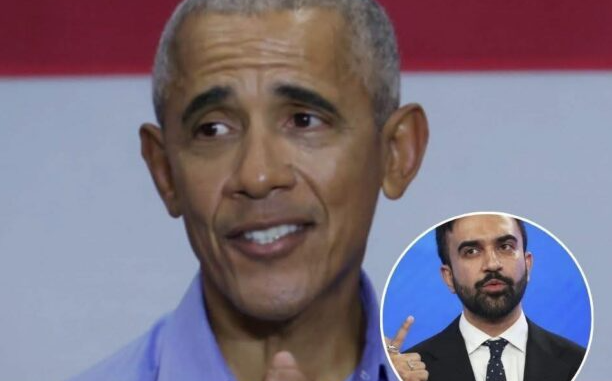

As one of the most closely watched elections in the nation reached its final hours, former President Barack Obama made a subtle yet significant move that sent ripples through the Democratic Party — and possibly reshaped the dynamics of a race that many observers already called too close to call.
The race in question: New York City’s heated mayoral contest between Zohran Mamdani, the Democratic nominee and self-proclaimed democratic socialist, and Andrew Cuomo, the independent candidate and former governor of New York. What might have been a predictable blue-city election has instead become a referendum on the future direction of the Democratic Party itself.
And with polls about to close, Obama’s decision not to formally endorse Mamdani — while quietly campaigning for a more moderate Democrat in another state — is being read by political insiders as a telling act of distance from the party’s progressive wing.
Obama’s Carefully Timed Move
Over the weekend, Barack Obama spent his time in New Jersey, campaigning for Democratic gubernatorial candidate Mikie Sherrill, whose centrist record and bipartisan appeal align more closely with the political style Obama championed during his presidency.
His absence from New York — where progressives had hoped he might lend even symbolic support to Mamdani — spoke volumes.
Instead, Obama placed a brief phone call to the socialist-leaning Democrat, which Mamdani’s campaign later described as “positive and encouraging.” However, no formal endorsement was issued, and the conversation’s content was kept vague.
“I appreciated the call with President Obama and his support for the movement that we have created,” Mamdani told reporters in City Hall Park. “I appreciated his words. I appreciated his time, and I appreciate this movement for putting us on the brink of delivering a new city in this place.”
His comments, though polite, could not conceal the campaign’s disappointment. For a candidate whose movement depends on the energy and legitimacy of national figures, Obama’s decision to stay neutral — or, as critics argue, to stay away — may have carried political consequences far beyond optics.
A Growing Rift Inside the Democratic Party
The tension between the party’s moderate establishment and its progressive insurgents has been growing for years. What began as a quiet philosophical divide during Obama’s presidency has now become an open battle over the party’s future — and Mamdani’s campaign embodies that struggle.
Mamdani, an Assemblyman from Queens, rose to prominence as part of a new wave of left-wing Democrats inspired by figures like Bernie Sanders and Alexandria Ocasio-Cortez. His platform calls for dramatic expansions in public housing, free public transit, and a municipal wealth tax — policies that many moderates have called “unrealistic” and “economically dangerous.”
Despite winning the Democratic primary in June, Mamdani has struggled to unite his party’s base heading into the general election. It took months before Governor Kathy Hochul and House Minority Leader Hakeem Jeffries reluctantly endorsed him, and even then, their support came across as tepid at best.
Jeffries, during a weekend interview, made headlines when he appeared to question Mamdani’s entire approach. “We have to be honest about the challenges our party faces,” Jeffries said. “We are the party of working families and progress, not the party of slogans and division. Far-left politics are not the future of the Democratic Party.”
Those remarks, interpreted as a thinly veiled criticism of Mamdani, underscored the growing anxiety among Democratic leaders that a Mamdani victory — or even a strong performance — could embolden progressive factions across the country.
Obama’s Record of Strategic Endorsements
Obama’s decision to campaign for Mikie Sherrill while staying away from New York was not unprecedented. The former president has been strategic with his endorsements, often choosing moderate candidates who can appeal to swing voters over those with more ideological platforms.
In 2013, for instance, Obama endorsed Bill de Blasio in New York’s mayoral race — but that endorsement came when de Blasio was running as a pragmatic progressive, not the firebrand he later became.