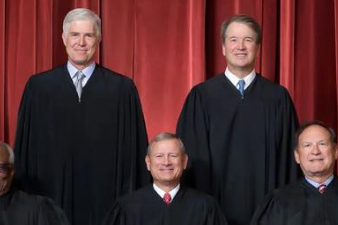

In the marble halls of the Supreme Court, a legal battle that has simmered for nearly a century reached a pivotal moment that could fundamentally alter the balance of power in Washington. What began as a dispute over one presidential appointment has evolved into a constitutional confrontation with implications that extend far beyond any single administration or political party.
The stakes of this judicial showdown reach into every corner of federal governance, touching questions that have divided legal scholars, political theorists, and presidents since the New Deal era. At its heart lies a fundamental question about American democracy: How much control should a president have over the vast federal bureaucracy, and what happens when unelected officials wield power that presidents cannot easily revoke?
The Commissioner Who Refused to Leave
The legal drama began in March when President Donald Trump moved to dismiss FTC Commissioner Rebecca Slaughter, a Democrat appointed by former President Joe Biden. What should have been a routine administrative action quickly became a constitutional crisis that would test the limits of presidential authority and challenge decades of established legal precedent.
Slaughter, whose seven-year term was set to run until 2029, represented more than just one Democratic voice on the commission. As the last Democratic appointee following Trump’s earlier dismissal of Commissioner Alvaro Bedoya, her removal would effectively give Republicans complete control over the Federal Trade Commission, one of the most powerful regulatory agencies in the federal government.
The timing of Trump’s action was strategic and significant. By moving quickly to reshape the FTC’s composition, the president signaled his intention to pursue an aggressive deregulatory agenda that would require cooperative commissioners willing to dismantle many of the policies implemented during the Biden administration.
Slaughter’s decision to fight her dismissal in court, rather than quietly accepting it like her colleague Bedoya, transformed what could have been a minor political dispute into a landmark constitutional case. Her legal challenge forced the courts to grapple with questions about presidential power that had remained largely settled since the 1930s.
The personal stakes for Slaughter were enormous. Not only did her legal career hang in the balance, but her resistance represented the broader Democratic Party’s attempt to preserve some institutional power in the face of complete Republican control of the federal government.
The 1935 Precedent Under Fire
At the center of this legal battle stands a 1935 Supreme Court decision, Humphrey’s Executor v. United States, which has governed presidential removal power for nearly nine decades. The case established that presidents cannot remove certain federal commissioners without cause, creating a category of quasi-independent officials who serve fixed terms regardless of which party controls the White House.
This precedent emerged during the New Deal era as part of a broader effort to insulate certain government functions from political interference. The theory was that agencies like the FTC needed stability and independence to carry out their regulatory missions effectively, free from the political pressures that might compromise their decision-making.
The Humphrey’s Executor decision reflected a particular view of government that saw value in creating pockets of expertise and continuity that could survive changes in political leadership. Under this framework, commissioners could only be removed for “inefficiency, neglect of duty, or malfeasance in office” – not simply because a new president disagreed with their policy positions.
For Trump’s legal team, this 90-year-old precedent represents an unconstitutional limitation on presidential authority. Solicitor General D. John Sauer argued that “the president and the government suffer irreparable harm when courts transfer even some of that executive power to officers beyond the President’s control.”
This argument reflects a broader conservative legal theory known as the “unitary executive,” which holds that the Constitution grants the president complete control over the executive branch. Under this interpretation, any limitation on the president’s ability to remove executive officials violates the constitutional separation of powers.
The stakes of this constitutional debate extend far beyond the FTC. If the Supreme Court overturns or significantly narrows Humphrey’s Executor, it could affect the independence of numerous federal agencies, from the Federal Reserve to the Securities and Exchange Commission.