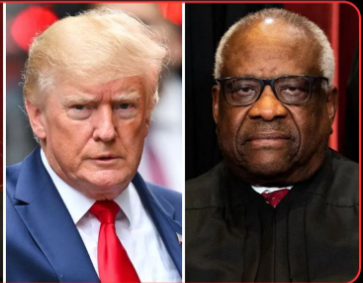

The Supreme Court on Friday permitted the government to freeze more than $4 billion in foreign aid payments that President Trump moved to cancel last month through a rare “pocket rescission.”
In a 6-3 decision, the justices granted the Trump administration’s emergency appeal, halting a Sept. 3 lower court ruling that had ordered the previously appropriated funds to be released.
“This is a massive victory in restoring the President’s authority to implement his policies,” a spokesperson for the White House Office of Management and Budget told the New York Post. “Left-wing groups’ ability to seize control of the president’s agenda has been shut down.”
The majority of the justices found the “harms to the Executive’s conduct of foreign affairs appear to outweigh the potential harm faced by respondents.” They include the AIDS Vaccine Advocacy Coalition, Journalism Development Network, Center for Victims of Torture and the Global Health Council, The Post noted.
The Supreme Court’s ruling stopped short of weighing in on the larger issue of whether President Trump has the authority to unilaterally “impound” funds approved by Congress.
Last month, Trump formally notified House Speaker Mike Johnson (R-La.) of his move to cancel more than $4 billion in foreign aid, including $3.2 billion in U.S. Agency for International Development (USAID) programs, $322 million from the joint USAID–State Department Democracy Fund, and $521 million in State Department contributions to international organizations.
The request, known as a “pocket rescission,” was submitted to Congress so close to the end of the fiscal year on Sept. 30 that it would automatically take effect regardless of congressional action.
It marks the first time in nearly five decades that a president has used the maneuver.
The funding in question had been designated for nonprofit organizations currently suing the Trump administration, as well as for foreign governments.
Earlier this month, U.S. District Judge Amit Mehta Ali, a Biden appointee, ruled that the administration could not withhold the money without congressional approval of the rescission proposal.
“To date, Congress has not responded to the President’s rescission proposal by rescinding the funds,” Ali wrote. “And the [Impoundment Control Act] is explicit that it is congressional action — not the President’s transmission of a special message — that triggers rescission of the earlier appropriations.”
The nonprofit organizations challenging the Trump administration’s funding freeze contended that the pocket rescission violated federal law and jeopardized critical, lifesaving programs overseas.